Opera
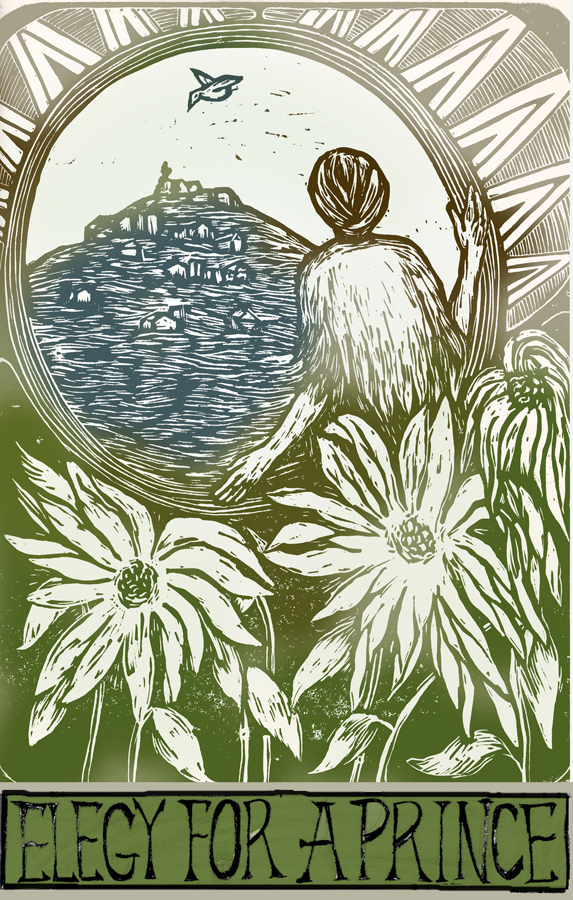 Original print created by artist Meredith Stern to advertise and showcase the opera for New York City Opera’s VOX competition in 2007.
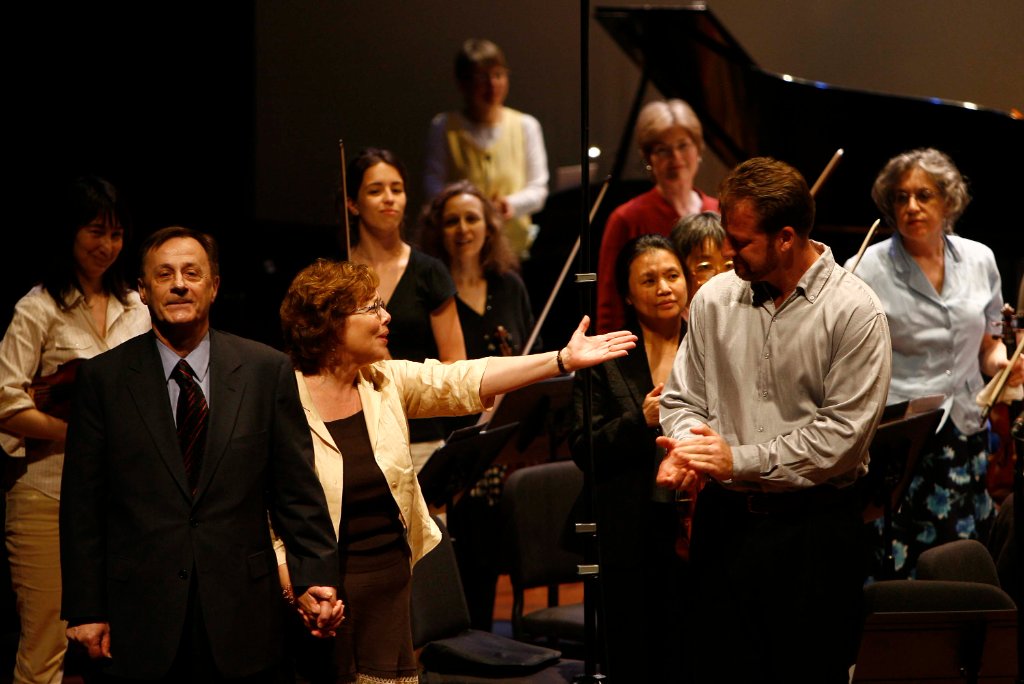 VOX Opera Showcase, Skirball Center NYU, May 12, 2007
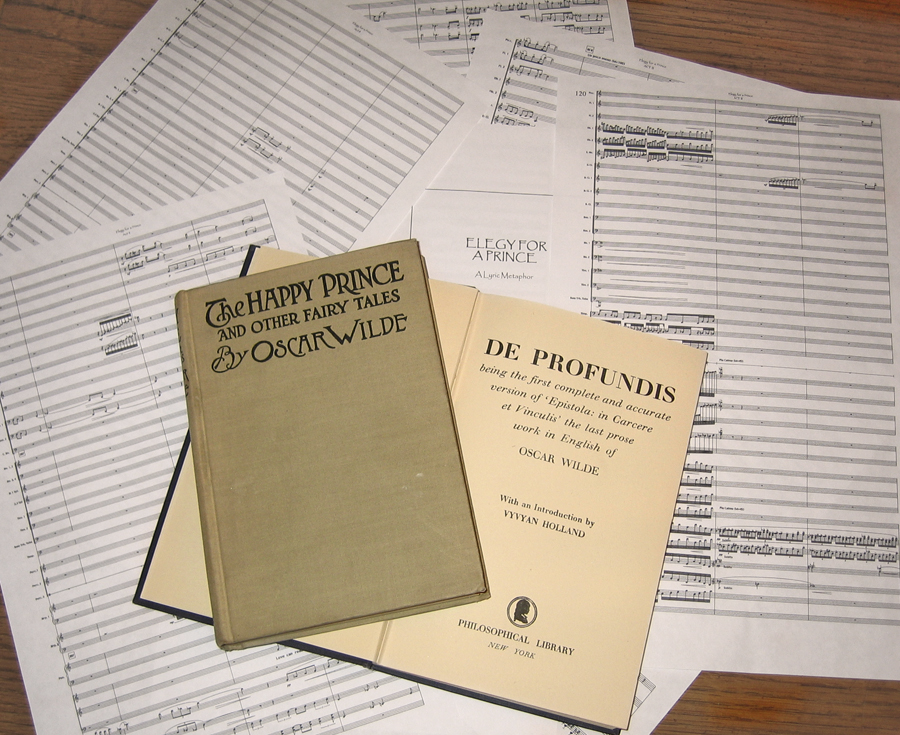 Parts of Sergio Cervetti’s original draft for Elegy for a Prince and original sources of Oscar Wilde’s work from which I developed the libretto.
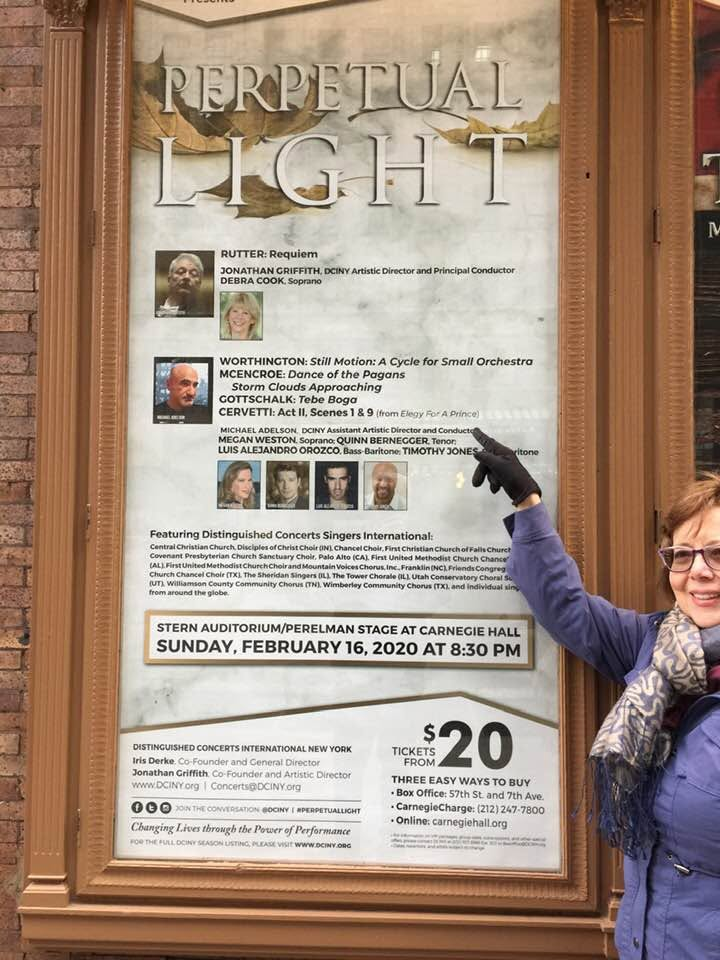 at Carnegie Hall, February 16, 2019
Learn more about Elegy for a Prince and listen to sections of it at the composer's website sergiocervetti.com
A Note from the Librettist
I had the joy of writing the libretto for Elegy for a Prince, an opera in two acts with an incredible score by Doylestown composer, Sergio Cervetti. The opera is rooted in Oscar Wilde’s fairy tale, The Happy Prince, and borrows from Wilde’s De Profundis. It moves beyond the touching fairy tale to show a young vagabond from Egypt marginalized by society. It reflects the inhumanity in society today but offers hope through loving gestures of individuals. Both Sergio and I loved this story as children, and we share our belief in the beauty of Elegy for a Prince.
Elegy for a Prince premiered in excerpts in 2007 at NYU’s Skirball Center when it was selected as part of New York City Opera’s VOX Opera Showcase. In February 2019, a month before COVID shut down the world, the second act of Elegy for a Prince was performed in concert at Carnegie Hall.
In order to build the libretto into a story that moves beyond Wilde’s fairy tale, I borrowed from his treatise on love and sorrow, De Profundis. Copyright issues required me to consult with early versions at the New York Public Library and eventually correspond with Wilde’s grandson, Merlin Holland. He graciously granted me permission to use excerpts from De Profundis.
For me, many experiences lead to poetry, including my time in the Rare Books Room of the 42nd Street Library in New York.
Solo Lunch After Research in the Library
Overview
Elegy for a Prince is adapted from “The Happy Prince” by Oscar Wilde. The original story is a fairytale. Swallow is a self-confident bird migrating to his home in Egypt before the onset of winter. He seeks shelter for the night between the feet of a gold and jewel encrusted statue of a deceased Prince. He is surprised by tears that fall from the statue as the Prince laments that he was blind to human suffering during his life. Elegy for a Prince develops these characters beyond the original tale and modifies the imaginative core by asking the audience to take a leap of faith. There is clearly a glittering statue of the Prince on stage, but he is also a human figure who sees poverty and suffering from his position overlooking the town.
Likewise, people in the town sometimes see Swallow as a bird and other times as a stealthy youth—perhaps a thief. Both are strangers, and they are marginalized by the townspeople. A Professor of Ornithology notes that a swallow in winter is “a curious sight.” In Act I, Scene 1, The Mayor asks: “A bird? A boy?” Accusingly he warns: “A thief! A vagabond!”
After their chance meeting, the immobilized Prince asks Swallow to delay his flight to Egypt so he can help the poor with his jewels. Swallow resists, but the Prince induces him to stay for one night, pluck the ruby from the hilt of his sword, and take it to a mother with a sick child. The following night the Prince persuades him again and commands that he take one of his sapphire eyes to a starving Young Writer who cannot complete his play. On the third night the Prince tells Swallow to take his remaining sapphire eye to a poor Match-Girl who has dropped her matches in the wet gutter; terror awaits if she returns home without money. Swallow is reluctant, but the Prince insists.
At the end of Act I, The Prince is blind. Swallow declares, “I will stay with you always—I will be your eyes.” He moves close to the Prince and “their bodies form a single image against the sky.” Swallow feels sorrow and empathy for the first time.
YUM!
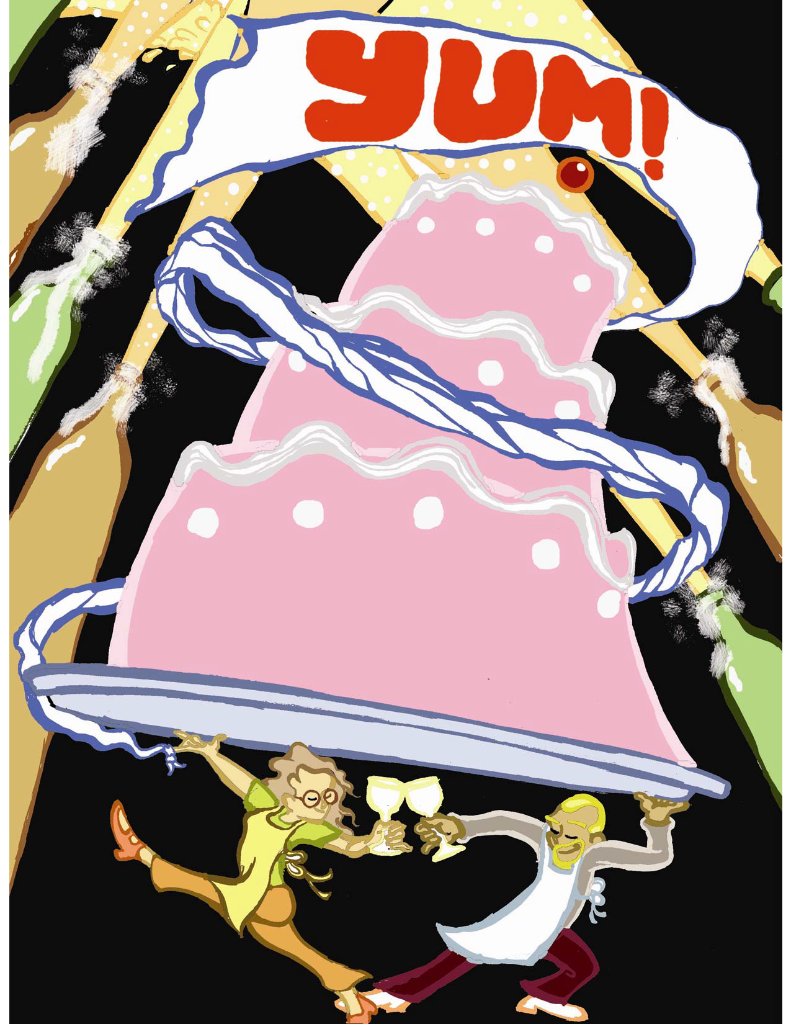 Original interpretation of YUM! by artist Jonathan Gies.
YUM! is a vibrant, humorous opera in one act that can be performed on a bare stage with only a few props—spoons, bowls, aprons, wine bottles. There are two characters—Sam and Isabelle—and a voice off stage, Kenneth.
Sam and Isabelle are old friends and competitive cooks. Egos are tested when both plan to make a cake for the 40th birthday of Kenneth, who is to each, is “my oldest, dearest friend.” They compromise and agree to collaborate on the cake—but not without challenges.
Inquiries about music and lyrics can be sent to the Contact Page. In addition, please check out sergiocervetti.com.